1. Wafer-style butterfly check valves feature a disc-shaped valve element that rotates around an axis within the seat passage. Due to the streamlined internal flow path, flow resistance is lower than that of lift-type check valves. They are suitable for large-diameter applications with low flow velocities and infrequent flow changes but are not recommended for pulsating flow; their sealing performance is inferior to that of lift-type valves. Butterfly check valves come in single-disc, double-disc, and multi-disc varieties-categorized primarily by valve diameter-designed to mitigate hydraulic shock when flow stops or reverses.
2. Lift-type check valves feature a disc that slides along the vertical centerline of the valve body. Internally threaded lift check valves must be installed on horizontal pipelines; for high-pressure, small-diameter valves, a spherical disc may be used. The body shape of this type of lift check valve resembles that of a globe valve (and parts are often interchangeable), resulting in a relatively high fluid resistance coefficient. The structure is similar to a globe valve, with identical body and disc components. Guide sleeves are machined into the upper part of the disc and the lower part of the bonnet, allowing the disc guide to move freely up and down within the bonnet guide. When flow occurs, the disc opens via the medium's thrust; when flow stops, the disc drops onto the seat under gravity, preventing backflow. In straight-through lift check valves, the inlet/outlet flow direction is perpendicular to the seat passage direction; in vertical lift check valves, the inlet/outlet flow direction aligns with the seat passage direction, resulting in lower flow resistance compared to the straight-through type.
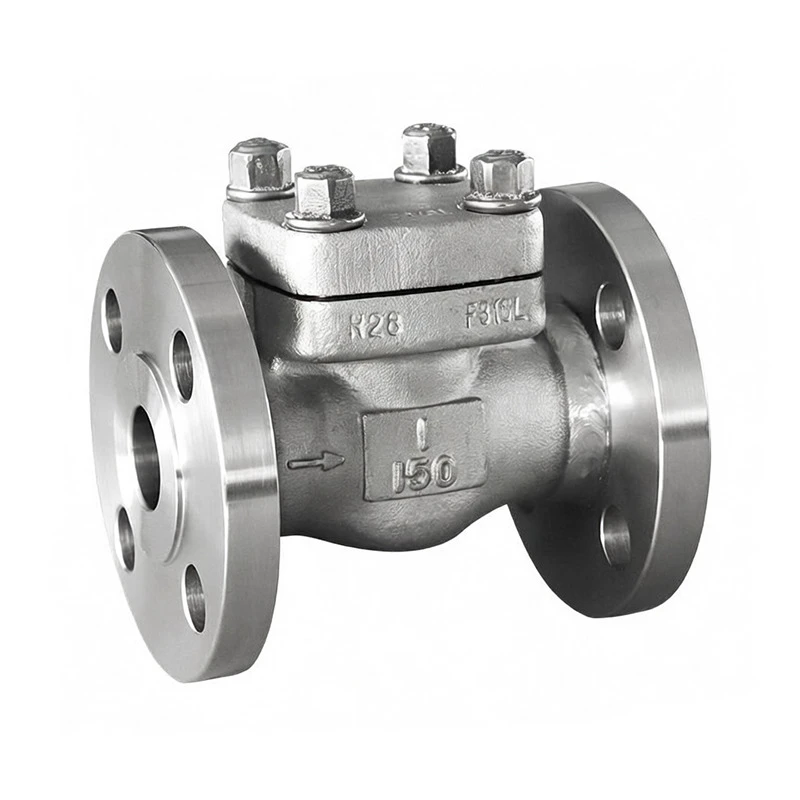
3. Forged steel check valves: These feature a disc that rotates around a pin within the seat. They have a simple structure, offer good sealing performance, and must be installed on horizontal pipelines.
4. Wafer-style check valves: Valves in which the disc slides along the valve body's centerline. Pipeline-style check valves represent a newer development; they are compact, lightweight, and offer good manufacturability, marking a key trend in the evolution of check valves. However, its fluid resistance coefficient is slightly higher than that of a swing check valve.
5. Compression-type check valve: This type of valve is used for boiler feedwater and steam shut-off applications; it combines the functions of a lift check valve with those of a globe valve or angle valve.
In addition, there are certain check valves-such as foot valves, spring-loaded types, and Y-pattern valves-that are not suitable for installation at pump outlets.